
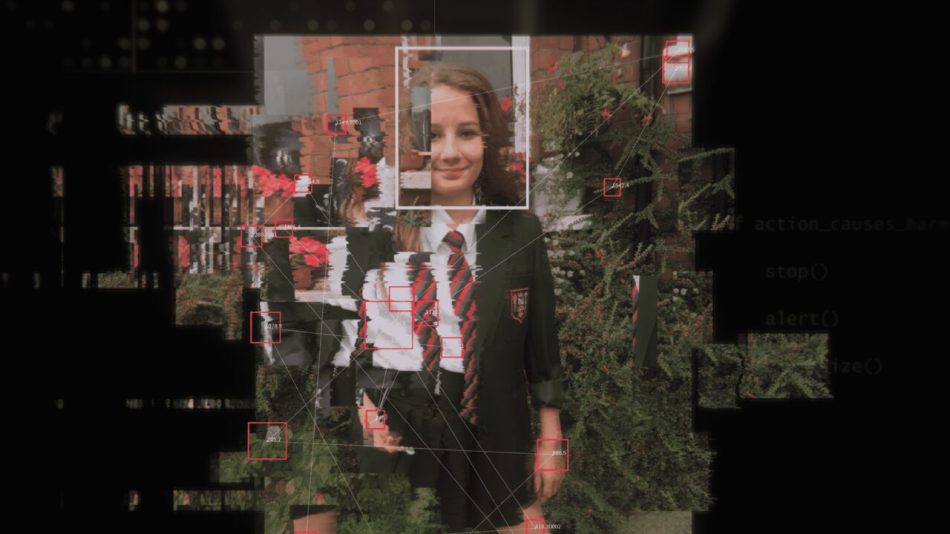
On the surface, Marc Silver‘s didactic documentary Molly vs The Machines, screening at CPH:DOX after premiering earlier this month at Glasgow Film Fest, seems to be a clear-cut story of personal tragedy and the subsequent fight against its causes. But the longer the unilateral examination of the death of Molly Russell—that shook British media, even garnering international attention—repeats its warning, the more blatant its faults become. The most pressing of these go right to the core of the case of the 14-year-old British girl from a seemingly average middle-class family. One morning, her mother found Molly dead in her room. She had taken her own life after weeks, possibly months, of struggling with depression.
Her father Ian, stepping up as a social justice warrior adamant to prevent other parents from the disaster that befell him, claims to have been utterly unaware of Molly’s misery. That in itself may point to severe issues with trust, empathy, communication, and attention in what Ian Russell paints as the ideal and completely common family. “If it happens to us, it can happen to anyone,” he claims early on in a warning voice. Why it didn’t happen to the millions of other kids and young people spending most of their time online, neither he nor director Silver ask. There is an uncomfortable reluctance to go deeper into the subject of Molly’s depression.
Everyone seems determined to ignore the elephant in the room, which is the fact that Molly sought out the content which her father describes as “the bleakest of worlds.” When this content, which over and over is characterized as something unimaginably dark and disturbing, is ultimately presented in a slide show, it turns out to be rather tame. The opposite is suggested by the shocked faces of supporters of Ian’s cause, which is to rigorously regulate both digital content and public access to it. Never mind the negative consequences of this, especially for troubled teenagers who find support online and a way to express their feelings.
It seems to be mostly such images and writings created by other teenagers and young adults fighting depression which Molly sought out. The possibility that these pieces didn’t push her over the edge but kept her from it, at least for a while, is never considered. Banning all content on suicide, self-harm, and mental struggle could drive other people to take Molly’s course, a media executive warns. The fact that Ian apparently couldn’t care less points to the true intention of his very public crusade. It’s not about justice for his daughter, who would have needed the attention she’s getting now when she was alive.
It’s about pointing to a villain – someone else to blame, be it the tech bros of Silicon Valley, Instagram and Pinterest, or the specter of an invisible digital power lurking in children’s bedrooms and feeding them harmful content. The bitter truth which neither Molly vs the Machines nor the public interest initiative instrumentalizing her fate tries to see, is that these online images were not some AI claw dragging kids into the abyss. They were a mirror. Molly’s online behavior and social media searches reflected the growing darkness inside her. No one on screen ever asks where that darkness came from and what could have been done to contain it.
The ultimate and cynically revealing contradiction of Molly vs the Machines is the documentary’s use of AI. Visuals rely heavily on AI imagery, an artificially generated narrator “voice of Silicon Valley,” and flashy digital effects. In contrast, voices from experts, psychologists, or other kids are largely absent. Silver flaunts his use of AI as if it were some clever reinforcement of his argument against digital tools. But it only serves to highlight the deceptive double standards. Those campaigning for a ban on digital tools and social media content exempt themselves from it. Both Silver and Molly’s parents seem to consider themselves not only competent to judge which online content is safe but entitled to continue engaging with what they want to ban.
If content about suicide and depression were banned, where would public policing draw the line? Would a pop song be acceptable? A novel? A film? Silver never presents independent data that would show self-harm among teenagers had increased with the rise of social media. Even if it had: correlation is not causation. Banning digital content that addresses uncomfortable subjects would be like closing bridges because some people jump from them. While Molly vs the Machines is obsessing about what its titular character did, it is painfully disinterested in what she felt. This discrepancy may have more to do with her death than anything on social media.
Discover more from Cineccentric
Subscribe to get the latest posts sent to your email.
 Cineccentric
0 comments on “Molly vs the Machines (documentary) ★”